
SRF Engineering Analogy
Psychological Regulation Through Engineering Lenses
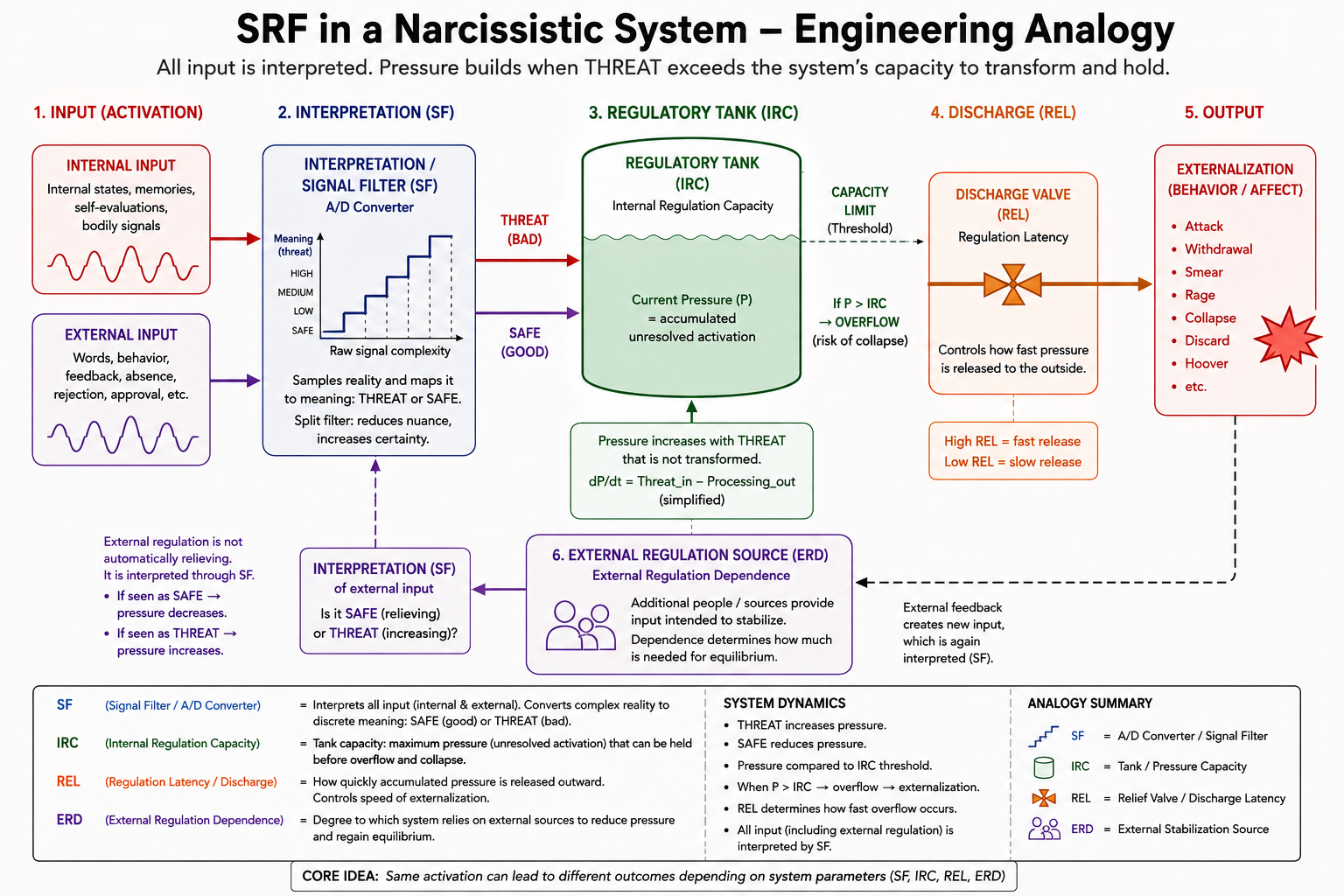
What this diagram shows
The Structural Regulation Framework translated into the language of engineering. Each SRF construct maps to a well-understood engineering concept — making the framework immediately intuitive to anyone who thinks in systems, signals, and control loops.
This is not metaphor for decoration. These mappings reveal structural similarities between psychological regulation and physical systems that engineers have modeled for decades. The math is different. The dynamics are analogous.
The mappings
IRC → Tank Capacity / Capacitance / Thermal Mass
How much the system can hold before overflow. A larger tank holds more water before spilling. A larger capacitor stores more charge before breakdown. Greater thermal mass absorbs more heat before temperature rises critically. IRC is the system's buffer size — how much unresolved activation can be contained internally.
SF → Pressure Relief Valve / Leakage Path / Heat Dissipation
The internal processing pathway. A pressure relief valve releases excess pressure safely before catastrophic failure. A leakage resistor bleeds charge gradually. Heat fins dissipate thermal energy to the environment. SF is the system's ability to process activation internally — transforming it rather than accumulating it to threshold.
REL → Response Delay / Time Constant / Thermal Lag
The temporal gap between input and output. In control systems, response delay determines how quickly the system reacts to disturbance. The RC time constant determines how quickly a capacitor charges. Thermal lag determines how quickly a material responds to heat input. REL is the system's response time — how quickly activation becomes external behavior.
ERD → Load Sensitivity / Gain / Thermal Conductivity
How strongly the system responds to input. High gain means small input produces large output. High thermal conductivity means heat transfers rapidly. High ERD means the same relational event produces disproportionate internal activation — the system is sensitized to external input.
Threshold → Burst Pressure / Breakdown Voltage / Ignition Point
The point of no return. Every contained system has a limit. Beyond burst pressure, the vessel fails. Beyond breakdown voltage, the insulator conducts. Beyond ignition point, combustion begins. The psychological threshold is where internal regulation fails and externalization becomes inevitable — not chosen, but mechanically determined.
Vectors → Discharge Paths / Current Routes / Heat Flow Directions
Where energy goes when the system exceeds capacity. Current follows the path of least resistance. Heat flows toward the coldest sink. Water finds the lowest point. Externalization flows through the individual's habitual vectors — validation, dominance, shame-defense — determined by developmental history and structural organization.
Why engineering analogies work
These are not loose metaphors. They work because psychological regulation and physical systems share fundamental properties:
- Conservation: Activation doesn't disappear — it is held, processed, or discharged
- Thresholds: Systems have limits beyond which behavior changes qualitatively
- Dynamics: Timing matters — the same input at different rates produces different outcomes
- Path dependence: Where energy goes depends on system structure, not just energy magnitude
- Feedback: Output affects input — externalization changes the relational environment which changes activation
The control theory perspective
In control theory terms, healthy regulation is a stable feedback loop: disturbance enters, the controller (IRC + SF) processes it, and the system returns to setpoint without oscillation. Dysregulation is an unstable loop: the controller is too slow (long REL + low SF), too sensitive (high ERD), or too small (low IRC) — and the system oscillates or saturates.
Therapy, in this framing, is controller tuning: increasing gain margin (IRC), improving phase margin (SF), and optimizing response time (REL) until the loop is stable under expected disturbances.
Key insight
Psychological regulation follows the same structural logic as any physical system managing energy under constraints. The vocabulary is different. The dynamics are the same. Understanding this removes moral judgment and replaces it with engineering clarity: the system is not broken because someone is bad. It is operating exactly as its parameters predict.
Where the analogy breaks
Physical systems don't modify their own parameters. Psychological systems do — through learning, therapy, and relational experience. Physical systems don't have motivated resistance to parameter change. Psychological systems do — because changing parameters means tolerating instability during the transition. And physical systems don't have meaning. Psychological regulation is embedded in identity, attachment, and narrative in ways that pure engineering cannot capture.