
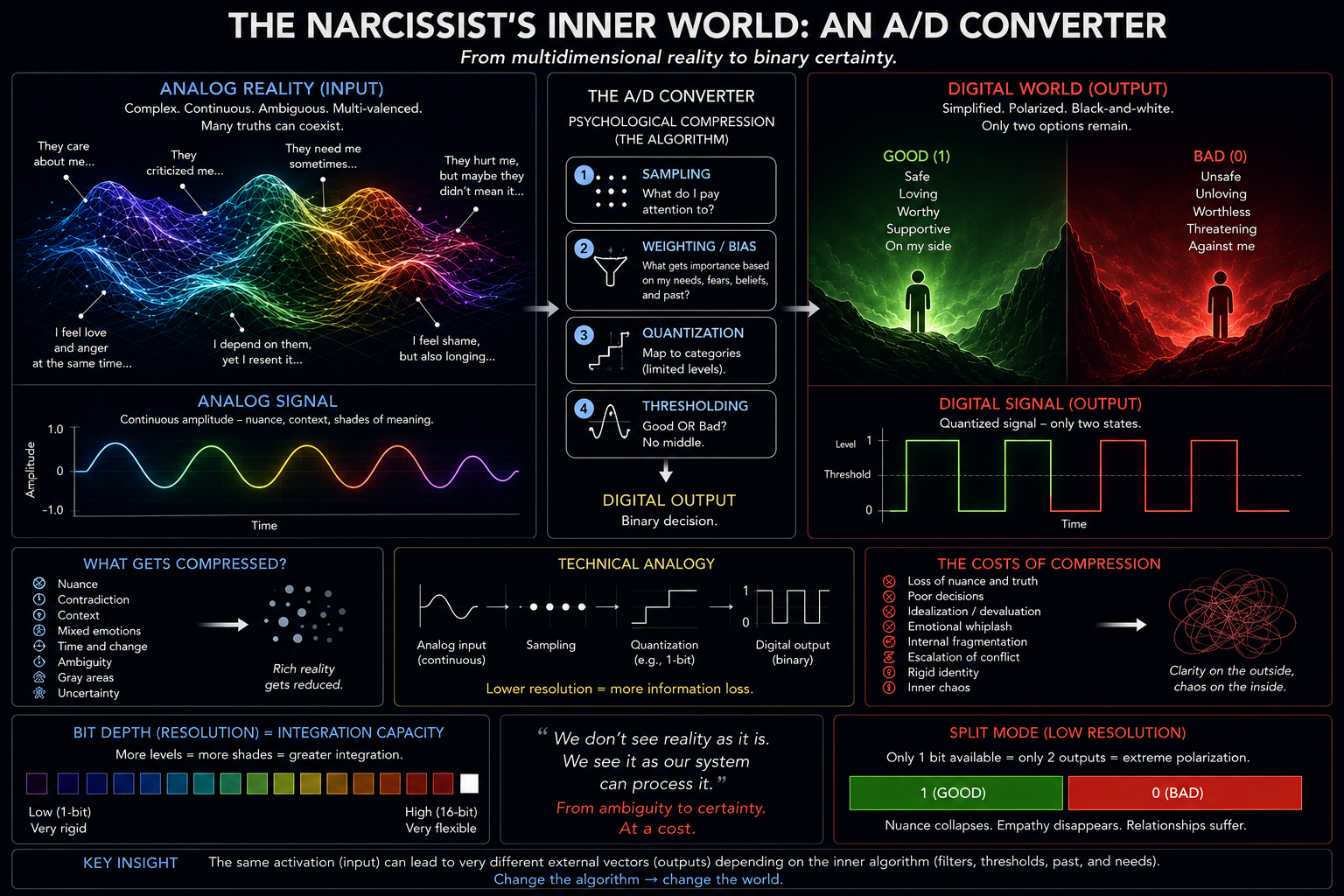
The A/D Converter
Perception as Analog-to-Digital Conversion
What this diagram shows
Relational reality is analog — continuous, nuanced, infinitely gradated. But the psychological system must convert this continuous signal into something it can process. Like an analog-to-digital converter, the system samples the continuous input and quantizes it into discrete levels. The number of available levels — the bit depth — determines how much nuance survives the conversion.
The A/D conversion analogy
Analog Input: Relational Reality
The raw signal is continuous. A person's behavior exists on an infinite gradient — not "good" or "bad" but somewhere in a vast space of intentions, contexts, histories, and momentary states. This is the analog signal: rich, complex, and requiring significant processing bandwidth to represent faithfully.
Sampling Rate: Attention and Presence
How frequently the system samples the incoming signal. Under high activation, sampling may become erratic — the system grabs snapshots rather than tracking the continuous stream. Under calm presence, sampling is more frequent and representative. Missed samples mean lost information.
Bit Depth: Structural Flexibility
The number of discrete levels available for representing the sampled signal. This is the critical variable — and it maps directly to SF's contradiction holding capacity:
- 1-bit (binary): Two levels only. Good/bad. Safe/dangerous. All/nothing. This is splitting.
- 4-bit: 16 levels. Some gradation. "Mostly good with some concerning patterns."
- 8-bit: 256 levels. Rich representation. Can hold complexity, ambivalence, contradiction.
- High-resolution: Near-analog fidelity. Full nuance preserved. "This person is complex and I can hold all of it simultaneously."
Quantization Error: What Gets Lost
Every A/D conversion introduces quantization error — the difference between the true analog value and the nearest available discrete level. At 1-bit depth, the error is enormous: everything between "perfect" and "terrible" gets rounded to one or the other. At high bit depth, the error is negligible. The person's representation closely matches reality.
Why bit depth matters more than the signal
Two people can receive the same analog input — the same partner behavior, the same ambiguous message, the same relational event — and produce completely different digital representations. Not because they received different signals, but because they converted at different bit depths.
The 1-bit system produces: "They didn't reply → they don't care → bad."
The 8-bit system produces: "They didn't reply → could be busy, could be
upset, could be distracted → I'll hold the uncertainty and check later."
Same input. Different converter. Different output.
Increasing bit depth
You cannot increase bit depth by instruction. Telling a 1-bit system to "see more nuance" is like telling a 1-bit ADC to output 256 levels — the hardware doesn't support it. Bit depth increases through:
- Survived complexity: Each experience where contradiction was held without collapse slightly increases available levels.
- Safe relational context: Lower activation allows the system to allocate more resources to resolution rather than speed.
- Repeated exposure: The same type of ambiguity, encountered many times without catastrophe, gradually expands the representational space.
Under load: dynamic bit depth reduction
Even high-resolution systems reduce bit depth under extreme activation. This is normal — like an audio system that clips under overload. Under sufficient stress, attachment activation, or threat, anyone's converter temporarily drops to fewer bits. The difference between integrated and non-integrated systems is not whether reduction happens, but how quickly full resolution returns after the activation passes.
Key insight
The problem is never the signal. The signal is always complex. The problem is always the converter. A system that can only represent reality in 1 bit will experience a nuanced world as binary — not because the world is binary, but because that's the maximum resolution the system can currently render. Therapy is hardware upgrade, not software patch.
Where the analogy breaks
Real ADCs have fixed bit depth determined by hardware. Psychological systems have dynamic, context-dependent resolution that changes with activation level, relational safety, and developmental history. The analogy captures the quantization mechanism but oversimplifies the plasticity. Additionally, psychological "conversion" is not passive sampling — it is motivated, defensive, and shaped by what the system can afford to perceive.