
SRF Electrical Circuit Model
Psychological Regulation as an Electrical Circuit
What this diagram shows
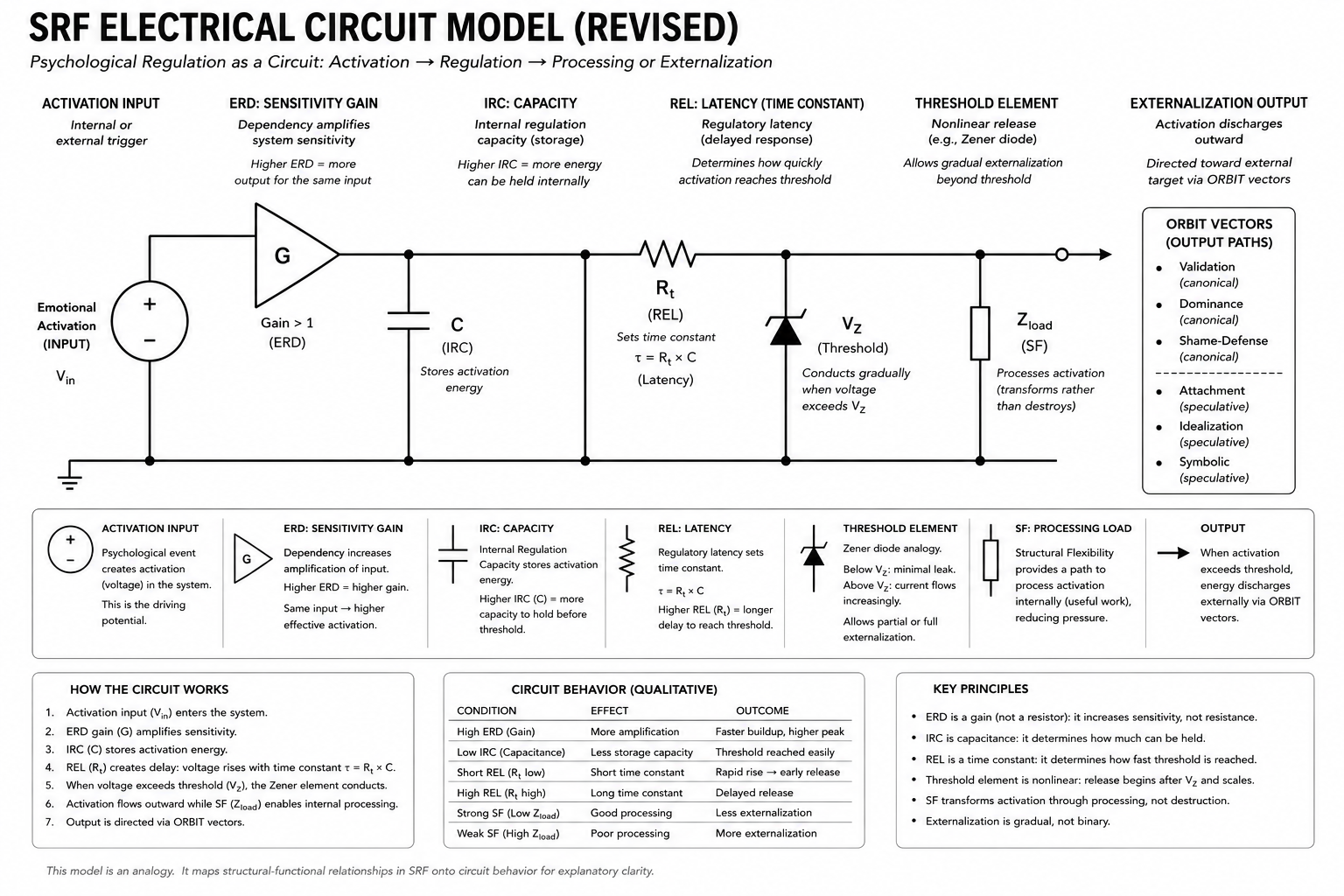
The Structural Regulation Framework reimagined as an electrical circuit. Each component of the framework maps to a circuit element, and the flow of emotional activation through the system follows the logic of voltage, capacitance, and discharge.
Component mapping
Activation Input (Voltage Source)
Emotional activation enters the system as voltage — generated by internal states or external events. This is the fundamental energy that the system must regulate. Every trigger, every relational event, every moment of uncertainty creates voltage in the circuit.
ERD — Dependency Load (Resistor)
External Regulation Dependence functions as a load that increases system sensitivity. Higher dependency means the same event creates more effective pressure in the system. A person with high ERD experiences the same ambiguous text message as a much larger voltage spike than someone with low ERD.
IRC — Internal Regulation Capacity (Capacitor)
The capacitor stores and holds activation energy internally. Higher IRC means larger capacitance — more energy can be stored before the system reaches its threshold. This is the holding capacity: how much unresolved tension can the system contain without discharging externally.
REL — Regulatory Latency (Inductor)
The inductor introduces delay before current flows. It resists sudden changes in current — creating the time interval between activation and behavioral response. This is REL: the temporal gap before externalization begins. The inductor allows time for internal processing or, if too long, for dangerous pressure buildup.
SF — Structural Flexibility (Leakage Resistor)
A parallel discharge path that allows activation to dissipate internally through integration and processing. Higher SF means more leakage — more energy is safely processed without ever reaching the threshold switch. This is the internal processing pathway: tension transformed rather than expelled.
Threshold Switch (Voltage Gate)
When activation voltage exceeds the system's capacity, the switch opens and energy discharges externally. This is the collapse point — the moment when internal regulation fails and externalization becomes inevitable. Not a choice. Circuit mechanics.
Externalization Output (Current via ORBIT Vectors)
Once the threshold is exceeded, activation flows outward through specific channels: validation-seeking, dominance, attack, withdrawal, idealization, rescue, or control. These are the directions externalization takes — not random, but determined by the individual's habitual vector profile.
System states
Key insight
Externalization is not random — it is circuit mechanics. When the system cannot hold more voltage, it discharges. The direction of discharge (which vector) and the speed of discharge (REL) are structural properties of the circuit, not moral failures of the person.
Where the analogy breaks
No analogy is perfect. In a real circuit, a resistor reduces voltage — but ERD increases effective sensitivity. SF as a leakage resistor dissipates energy as heat — but real structural flexibility transforms tension into something useful rather than merely dissipating it. The threshold switch is binary — but real externalization is often gradual. These are pedagogical simplifications, not precise formalizations.