
SRF Phase Transition Diagram
Water Metaphor of Psychological Regulation
What this diagram shows
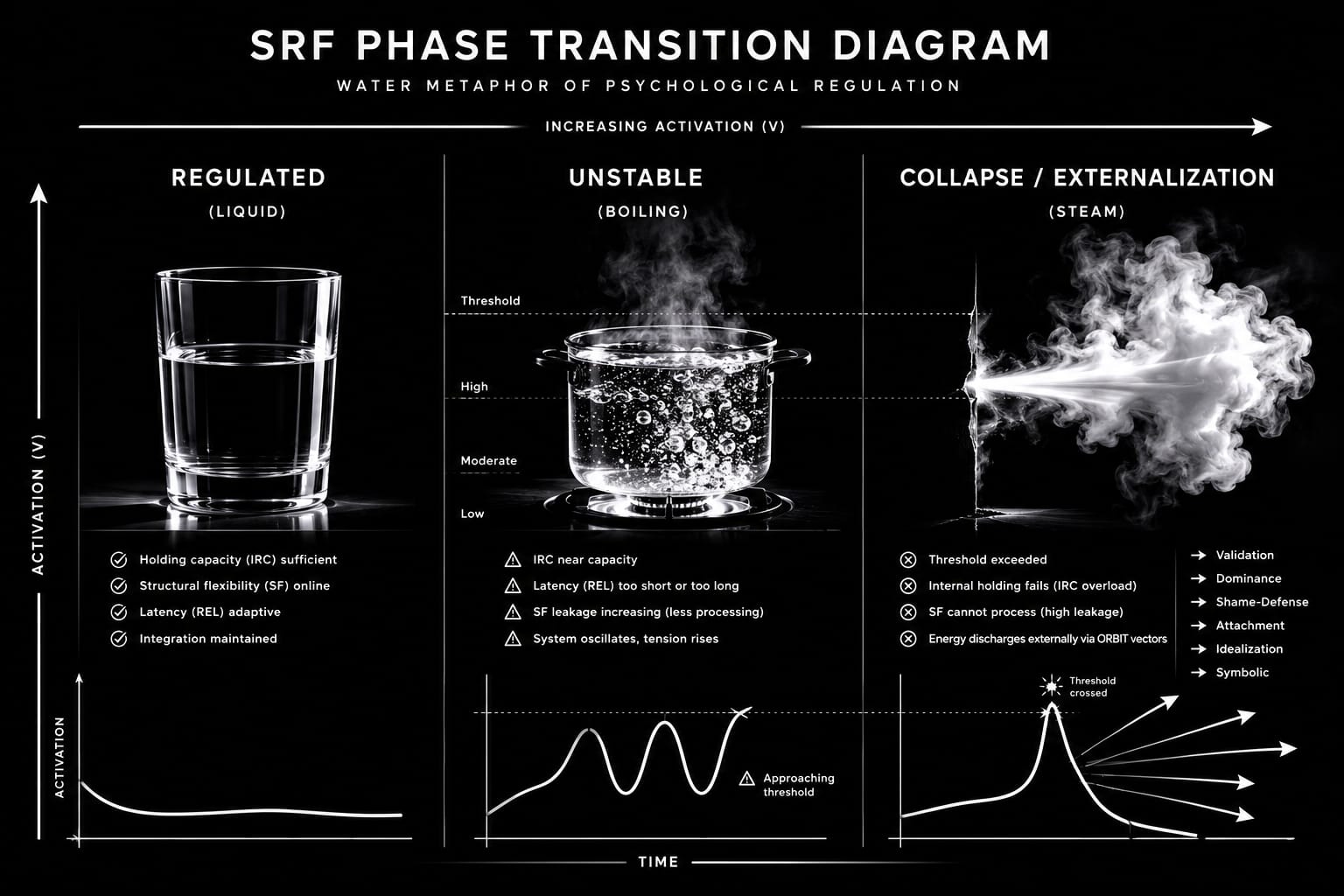
Psychological regulation modeled as phase transitions of water. As activation (heat) increases, the system moves through three distinct states — each with different properties, different risks, and different behavioral signatures. The transition between states is not gradual blending but a qualitative shift in how the system operates.
The three phases
Regulated (Liquid)
The system is contained. Activation exists but remains within holding capacity. Like water in a glass — present, visible, but not escaping its container.
- Holding capacity (IRC) sufficient
- Structural flexibility (SF) online — internal processing active
- Latency (REL) adaptive — neither too short nor too long
- Integration maintained — contradictions held without splitting
This is not the absence of tension. The glass contains water. The system contains activation. The point is that the container holds.
Unstable (Boiling)
Activation approaches capacity. The system oscillates — moments of containment alternating with moments of near-overflow. Like water at boiling point: still technically liquid, but turbulent, unpredictable, and approaching phase change.
- IRC near capacity — the container is almost full
- REL becomes erratic — too short (impulsive discharge) or too long (frozen suppression)
- SF leakage increasing — less internal processing, more pressure buildup
- System oscillates — tension rises and partially discharges in cycles
The activation graph at the bottom shows this oscillation: rising toward threshold, partially discharging, rising again. The system is working hard to stay contained but losing the battle incrementally.
Collapse / Externalization (Steam)
Threshold exceeded. The system undergoes phase transition — activation that was contained internally now escapes externally. Like steam: the same substance, but now uncontained, expanding outward, impossible to hold in the original vessel.
- Threshold exceeded — the container cannot hold more
- Internal holding fails (IRC overload)
- SF cannot process — leakage pathway overwhelmed
- Energy discharges externally via ORBIT vectors
The discharge is not random. It flows through specific channels — the individual's habitual externalization vectors: validation-seeking, dominance, shame-defense, attachment, idealization, or symbolic stabilization.
Why phase transition — not gradient
The metaphor is deliberately discontinuous. Water does not gradually become steam — it undergoes a qualitative state change at a specific threshold. Similarly, the framework proposes that externalization is not simply "more activation" but a structural shift in how the system operates.
Below threshold: activation is processed internally (liquid dynamics). Above threshold: activation escapes externally (gas dynamics). The rules change at the transition point. This is why someone can appear completely regulated one moment and completely dysregulated the next — it is not proportional escalation but phase change.
The activation curve
The graph at the bottom shows activation over time. In the unstable phase, activation oscillates — approaching threshold, partially discharging, rising again. Each oscillation brings the system closer to the transition point. When the threshold is finally crossed, the discharge is rapid and directional — flowing outward through ORBIT vectors.
This captures a common lived experience: the feeling of "holding it together" through repeated near-misses until one final trigger — often small — causes the full phase transition. The trigger is not proportional to the response because the system was already at boiling point.
Key insight
The "overreaction" is not an overreaction. It is a phase transition. The system was already at threshold — the final input merely crossed it. The energy that escapes as steam was accumulated over time as liquid. The explosion is proportional to the total accumulated activation, not to the final trigger.
Where the analogy breaks
Real psychological regulation is not as clean as thermodynamics. The threshold is not fixed — it shifts with fatigue, context, and relational safety. The "steam" can sometimes be recaptured (repair, de-escalation). And unlike water, psychological systems can increase their container size over time (IRC development through therapy or corrective relational experience). The metaphor captures the discontinuity of collapse but oversimplifies the plasticity of human regulation.