
SRF Attractor Basin Model
Regulation as a Landscape of Stability and Transition
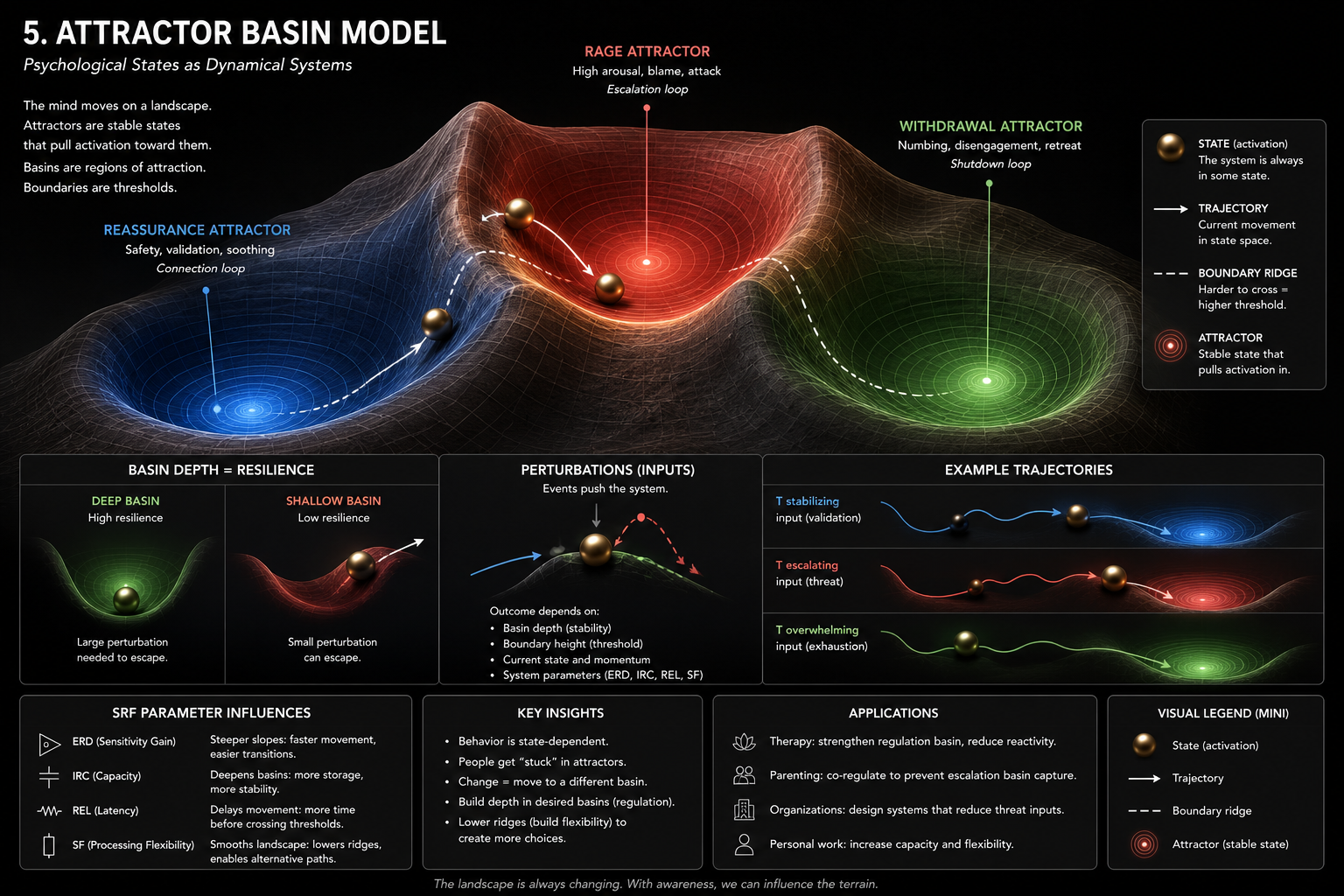
What this diagram shows
Psychological regulation modeled as a physical landscape. Each valley (basin) represents a stable regulatory state — a pattern the system naturally falls into and resists leaving. The hills between basins represent the energy required to transition from one state to another. A ball resting in a valley is a system in its habitual regulation mode.
The attractor basin metaphor
In dynamical systems theory, an attractor is a state toward which a system naturally evolves. A basin of attraction is the set of conditions from which the system will settle into that attractor. Deep basins are hard to escape — the system returns to them even after perturbation. Shallow basins are easily disrupted.
Applied to regulation: a person's habitual regulatory pattern is a deep basin. Therapy, crisis, or corrective experience can push the system over a hill into a new basin — but the old basin keeps pulling back until the new one deepens through repeated experience.
SRF mapping
Deep Basin: Habitual Regulation Architecture
The system's default operating mode. For someone with chronic ERD, this basin represents externalized regulation — the pattern the system returns to automatically under stress. For someone with high IRC + SF, the deep basin is integrated internal regulation. The depth of the basin represents how entrenched the pattern is.
Hills: Transition Thresholds
The energy required to move from one regulatory state to another. High hills mean the system strongly resists change — even when the current basin is maladaptive. This explains why insight alone rarely produces lasting change: understanding that you're in a suboptimal basin doesn't reduce the hill height. Only sustained activation (therapeutic relationship, crisis, repeated corrective experience) provides enough energy to cross.
Shallow Basin: Unstable New Pattern
Early therapeutic gains often feel fragile — because the new regulatory pattern is a shallow basin. Small perturbations (stress, relational trigger, fatigue) push the system back over the low hill into the old deep basin. This is not "relapse as failure" — it is the physics of a system that hasn't yet deepened its new attractor.
The Ball: Current System State
Where the system is right now. Under low activation, the ball rests at the bottom of its basin. Under high activation, it oscillates — climbing the walls, approaching the hill, sometimes crossing into a different basin temporarily before rolling back.
Why change is hard
The landscape explains several clinical observations:
- Insight without change: You can see the better basin from where you are — but seeing it doesn't flatten the hill between you and it.
- Relapse after progress: The new basin is shallow. Any significant perturbation rolls the ball back to the old, deeper basin.
- Crisis as catalyst: Extreme activation provides enough energy to cross hills that normal life cannot. This is why some people change only after breakdown.
- Gradual deepening: Each time the system spends time in the new basin, it deepens slightly. Repeated experience — not single insight — is what makes new patterns stable.
Connection to SRF constructs
IRC and SF determine the landscape shape. Higher IRC creates deeper internal regulation basins. Higher SF creates smoother transitions (lower hills) between adaptive states. ERD represents the depth of externalized regulation basins — how strongly the system is pulled toward external stabilization.
REL in this metaphor is the ball's momentum — how quickly it moves toward the basin wall (externalization) when perturbed. Short REL = the ball accelerates rapidly toward the edge. Long REL = the ball oscillates near the center before approaching the wall.
Key insight
Therapeutic change is not about willpower or understanding. It is about landscape modification — deepening new basins through repeated experience until they become the system's natural resting state. The old basin doesn't disappear. It just becomes shallower relative to the new one.
Where the analogy breaks
Real psychological landscapes are not static — they shift with context, fatigue, relational environment, and physiological state. The landscape itself changes as the ball moves through it. Additionally, humans can sometimes modify their own landscape intentionally (through practice, therapy, or environmental design) — unlike a passive ball on a fixed surface. The metaphor captures stability and transition dynamics but oversimplifies the system's self-modifying capacity.