
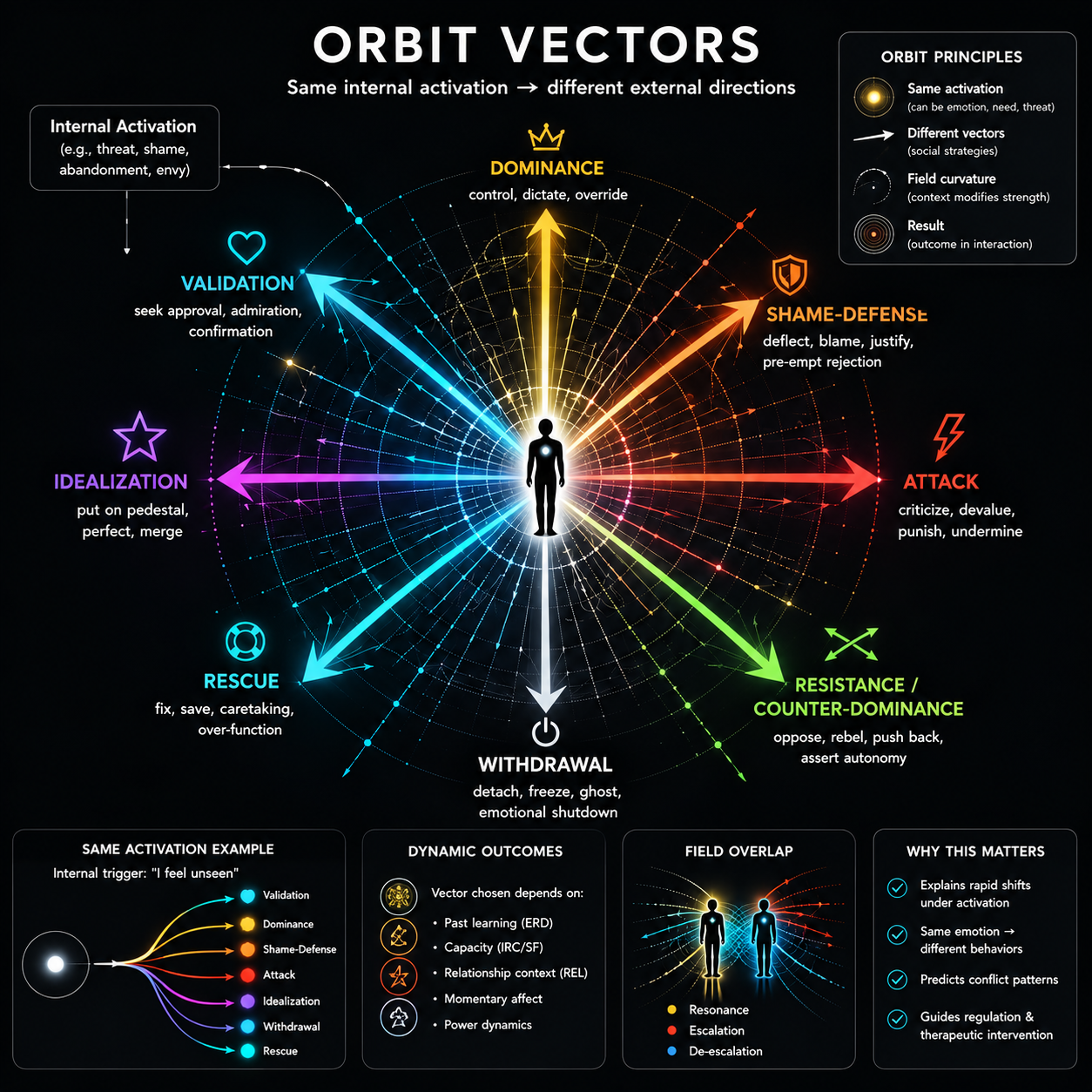
ORBIT Vectors
The Directions of Externalized Regulation
What this diagram shows
When regulation externalizes — when the system cannot hold activation internally and must discharge outward — it does not discharge randomly. It flows through specific directional channels. These channels are the ORBIT vectors: the habitual pathways through which a system seeks external stabilization.
This diagram maps those directions. Not as personality types, but as regulatory channels that can combine, shift, and vary in intensity depending on context, activation type, and developmental history.
The core principle
Externalization is directional. Two people with identical levels of external regulation dependence may externalize through completely different channels — one through validation-seeking, another through dominance, a third through shame-defense. The vector describes where the energy goes, not how much energy there is.
The vectors
Validation
Logic: "Stability requires external confirmation."
Mechanism: tension → insecurity → seek reflection → temporary stabilization
Stabilization through: approval, admiration, recognition, being seen
Activated by: identity tension, evaluative ambiguity
Dominance
Logic: "Stability requires environmental predictability."
Mechanism: tension → threat perception → control acquisition → stabilization
Stabilization through: predictability, hierarchy, power, compliance from others
Activated by: control tension, unpredictability, perceived challenge
Shame-Defense
Logic: "Uncontained shame becomes destabilizing."
Mechanism: tension → shame activation → self-protection → external distortion
Stabilization through: projection, blame-shifting, devaluation, rage
Activated by: shame tension, criticism, exposure, perceived inadequacy
Attachment
Logic: "Stability requires proximity."
Mechanism: tension → separation anxiety → proximity-seeking → stabilization
Stabilization through: closeness, fusion, physical presence, reassurance of availability
Activated by: attachment tension, separation threat, ambiguous availability
Idealization
Logic: "Stability requires a perfect object."
Mechanism: tension → inadequacy → symbolic amplification of other → stabilization
Stabilization through: merging with idealized figure, borrowed strength, reflected perfection
Activated by: identity tension, felt inadequacy, need for external anchor
Symbolic
Logic: "Stability requires meaning."
Mechanism: tension → meaninglessness → ideological anchoring → stabilization
Stabilization through: belief systems, group identity, ideology, cause, mission
Activated by: existential tension, identity vacuum, loss of purpose
Why vectors — not types
The framework explicitly rejects categorical subtyping. Vectors are not personality labels. They are directional tendencies that:
- Combine — a person may use validation + attachment simultaneously
- Shift — the same person may use dominance at work and validation in relationships
- Vary in intensity — a vector can be primary, secondary, or dormant
- Change over time — developmental experience can redirect externalization
This preserves dimensional structure and avoids recreating personality categories under new names.
Vectors and tension subclasses
Different tension types may preferentially activate different vectors — though these are tendencies, not fixed mappings:
- Identity tension → validation vector
- Control tension → dominance vector
- Shame tension → shame-defense vector
- Attachment tension → attachment vector
- Existential tension → symbolic vector
Key insight
Externalization is not one thing. Two people who both "can't regulate internally" may look completely different — one seeks reassurance, another seeks control, a third attacks. The vector determines the behavioral signature. Understanding the vector explains why the same underlying regulation deficit produces such different surface behaviors.