
The Compression Algorithm
Splitting as Lossy Data Compression
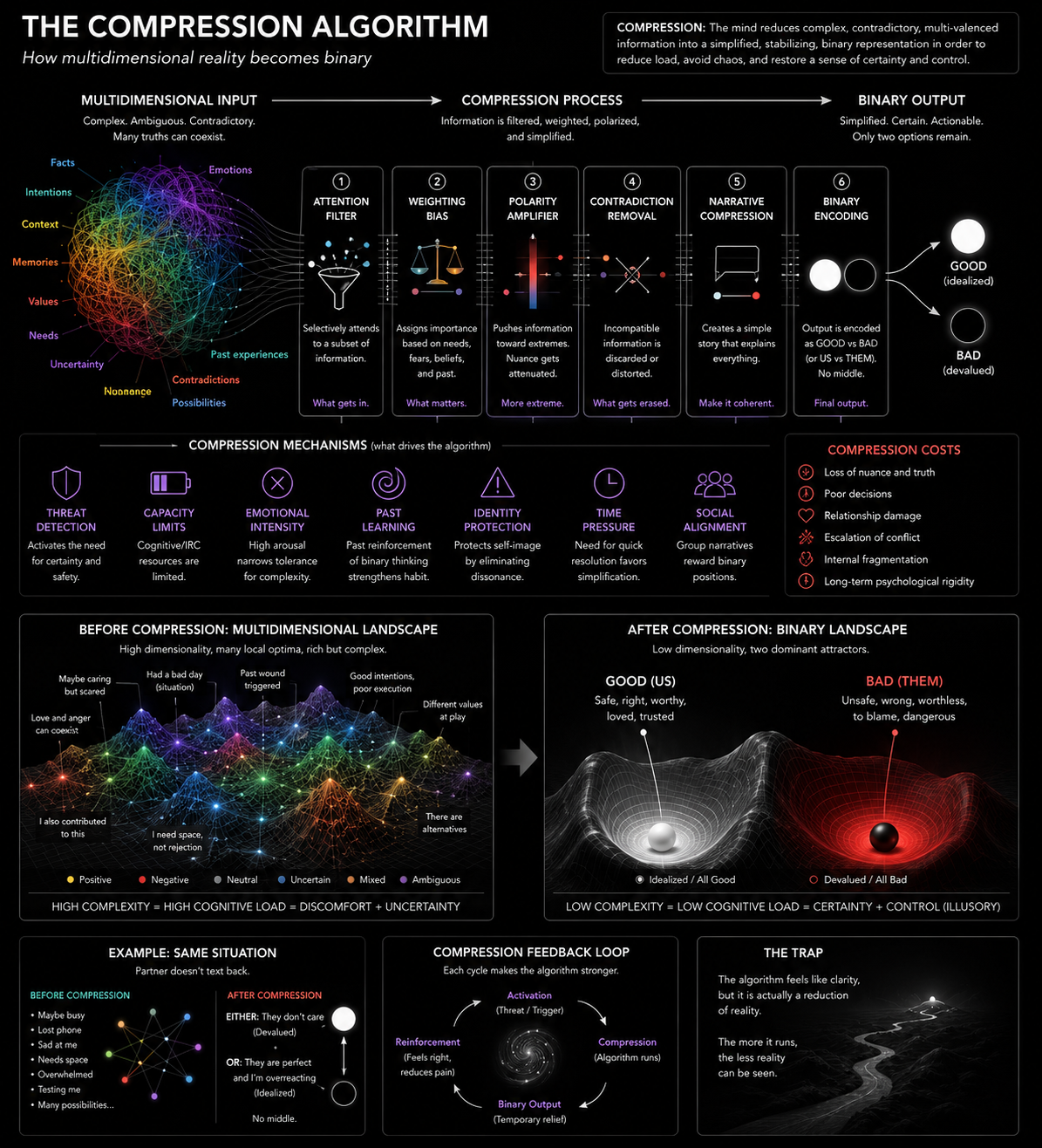
What this diagram shows
Splitting reframed as an information processing problem. When the system receives complex, contradictory relational data — "this person is both caring and hurtful, both reliable and disappointing" — it must process that information. If the system has sufficient capacity (structural flexibility), it holds the full-resolution signal. If not, it compresses.
And like all lossy compression, something is lost. The nuance. The grey. The "both/and." What remains is a binary signal: good or bad, safe or dangerous, idealized or devalued.
The information processing analogy
Input: Full-Resolution Relational Data
The raw signal is complex. A person is simultaneously kind and occasionally cruel, available and sometimes absent, loving and capable of disappointment. This is high-bandwidth information — it requires significant processing capacity to hold without simplification.
Processing Capacity: Structural Flexibility
SF determines the system's "bitrate" — how much complexity it can process without dropping data. High SF = lossless processing (holds the full signal). Low SF = lossy compression (must reduce to fit available capacity).
Output: Compressed Representation
When capacity is insufficient, the system compresses. The output is a simplified representation that fits within available processing bandwidth. In extreme cases: 1-bit encoding. Good or bad. Black or white. All or nothing.
Compression levels
Not all compression is equally severe. The framework implies a spectrum:
- Lossless (high SF): Full complexity retained. "This person hurt me and I still love them and both are true simultaneously."
- Mild compression: Some nuance lost but core structure preserved. "This person is mostly good but has this one flaw I struggle with."
- Heavy compression: Significant simplification. "This person is good but sometimes bad" — alternating, not simultaneous.
- Binary (1-bit): Maximum compression. All good OR all bad. No simultaneity possible. Splitting.
Why the system compresses
Compression is not a choice. It is what happens when incoming data exceeds processing capacity. The system does not decide to split — it splits because holding the uncompressed signal would destabilize the entire system. Binary encoding is a survival strategy: preserve coherence at the cost of accuracy.
This is why telling someone to "see the grey" doesn't work. You cannot process a signal at higher resolution than your hardware supports. The instruction is: "use capacity you don't have." Integration requires capacity expansion, not cognitive instruction.
Decompression = integration
Integration is the reverse process: gradually increasing the system's processing bandwidth until it can hold higher-resolution representations. Each survived contradiction — each moment where "both/and" was tolerable — slightly increases the bitrate. The compressed binary slowly gains resolution. Grey emerges not from thinking differently, but from being able to hold more.
Key insight
Splitting is not a distortion of reality. It is a compression of reality to fit available processing capacity. The person is not "seeing wrong" — they are seeing at the only resolution their system can currently render. Increasing resolution requires increasing capacity, not correcting perception.
Where the analogy breaks
Digital compression is deterministic and reversible given the codec. Psychological compression is neither — the "lost" information may not be recoverable because it was never fully encoded in the first place. Additionally, psychological systems actively resist decompression (because higher resolution means more activation to hold), while digital systems decompress passively. The analogy captures the mechanism but not the resistance.